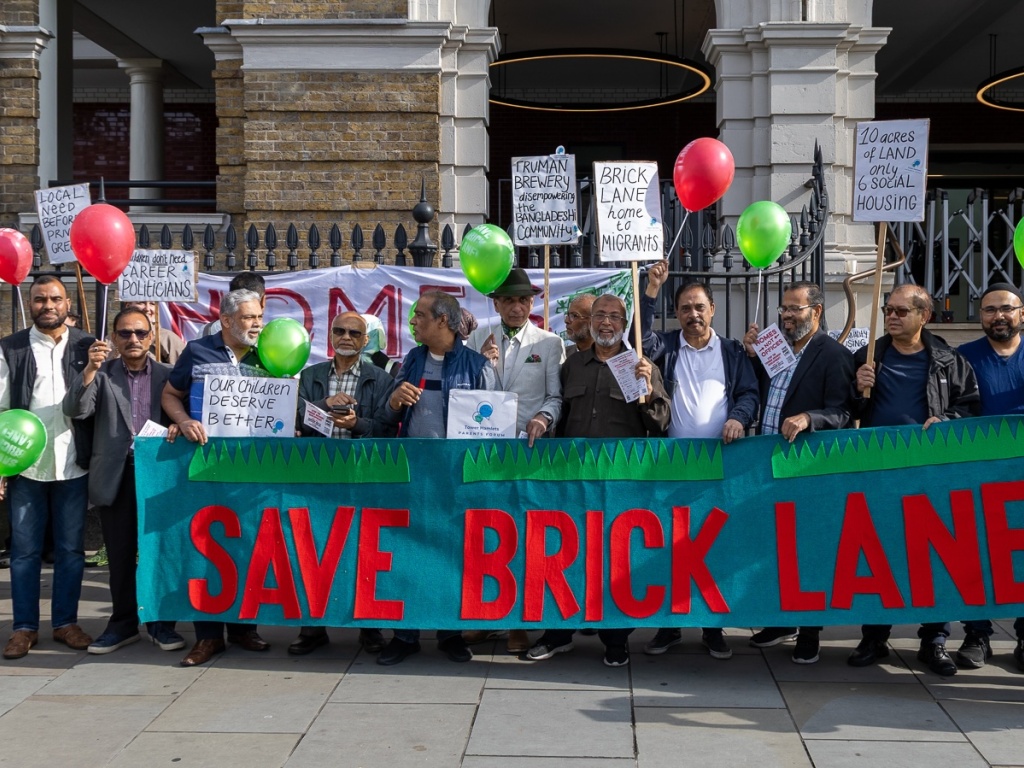
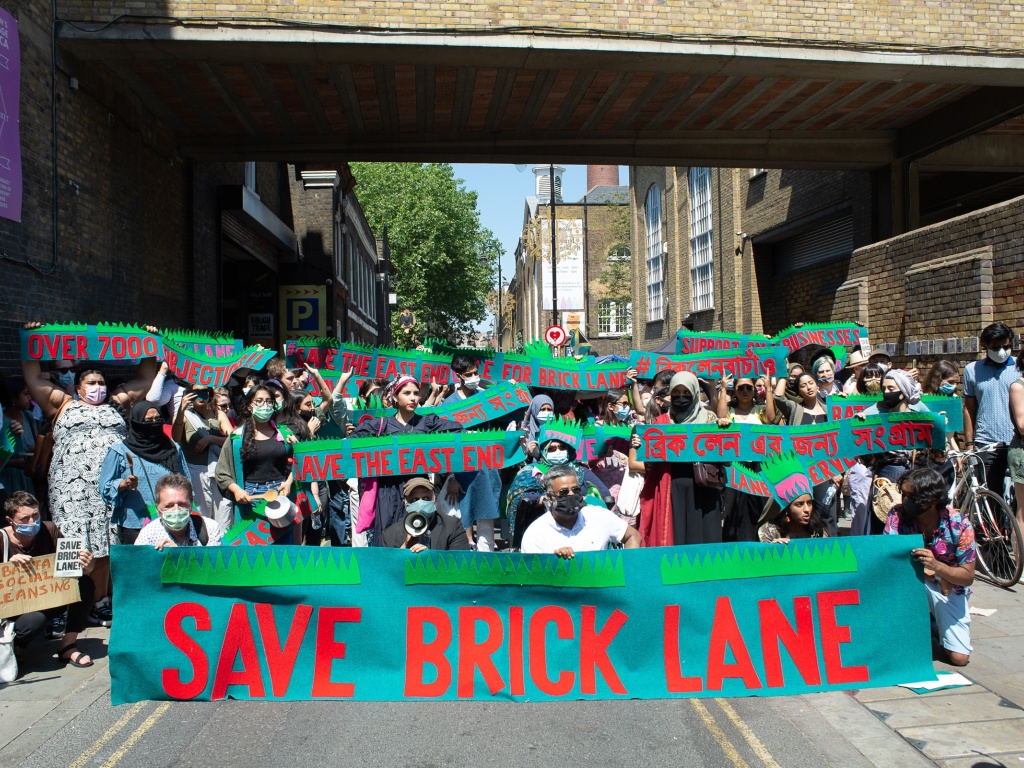
About the Campaign
Protecting Brick Lane's heritage, community and future
The Save Brick Lane Campaign is a community-led coalition rooted in the historic heart of London's East End. It was formed to protect the cultural, social and architectural character of Brick Lane, Spitalfields and Banglatown, and to argue for a future for the former Truman Brewery that responds to the needs of the people who live and work around it.
At the heart of the campaign is a fundamental question about conservation and urban development:
Who are historic places being conserved and developed for?
Brick Lane is not simply a collection of historic buildings. Its significance comes from the relationship between those buildings and generations of migrants, workers, craftspeople, traders and residents who have made this part of London their home.
On 29 July 2026, the Government approved four major development proposals on and around the Truman Brewery, overturning the position taken by Tower Hamlets Council and bringing a new phase in the long-running battle over Brick Lane.
The campaign continues.
At a Glance
29 July 2026: Government allows all four Truman Brewery planning appeals.
Four schemes approved: Grey Eagle Street data centre, Truman Brewery East redevelopment, Ely's Yard commercial development and listed-building works to the Boiler House.
44 homes: only 11 classified as affordable, including six social homes.
31 July 2025: Tower Hamlets Council's Strategic Development Committee unanimously resolves that the proposals should be refused.
October 2025: Save Brick Lane participates in the public inquiry as a Rule 6 Party.
Current status: Active — Government approval granted; campaign considering next steps.
Why Save Brick Lane?
Brick Lane is one of Britain's most distinctive historic urban neighbourhoods.
Its character has been created over centuries by successive communities: from Huguenot silk weavers and Jewish migrants to the Bengali community that established Banglatown, alongside generations of craftspeople, market traders, manufacturers and independent businesses.
The buildings tell this history, but so do the uses within them. Workshops, markets, curry houses, cafés, textile businesses, places of worship, independent shops, housing and the surviving industrial buildings of the former Truman Brewery together form a living historic environment.
The Truman Brewery occupies a particularly important position within this landscape. Its substantial industrial buildings and yards represent the area's brewing and manufacturing history, but the site is also one of the largest remaining opportunities to determine what kind of neighbourhood Brick Lane will become.
For this reason, the argument over its redevelopment has always been about considerably more than individual buildings.
It is about heritage, housing, land, community and who ultimately benefits from the redevelopment of the city.
What Has Been Approved?
The redevelopment is not a single building project. It consists of four related proposals across sites in and around the Truman Brewery:
a major data centre at Grey Eagle Street;
the large Truman Brewery East mixed-use redevelopment;
a new commercial building at Ely's Yard; and
works affecting the Grade II-listed Boiler House.
Together, the schemes introduce substantial new commercial development, offices, retail and other uses alongside a comparatively small amount of housing.
The wider development provides 44 homes, of which only 11 are classified as affordable and six as social housing.
For campaigners, this is particularly difficult to justify in a borough facing an acute shortage of affordable and social housing.
The controversy has consequently developed into a much wider debate about how scarce urban land should be used.
Homes or a Data Centre?
One of the most controversial elements is the proposed data centre at Grey Eagle Street.
Data centres are becoming increasingly important infrastructure for cloud computing, artificial intelligence, financial services and the wider digital economy. But they can also require very substantial electricity capacity and resources while providing relatively few permanent jobs compared with their scale and infrastructure requirements.
That creates an important public-policy question when such infrastructure competes with other demands for scarce urban land and energy.
Is a large data centre the best use of this land in the middle of one of London's most densely populated areas and in a borough experiencing an acute housing shortage?
The Save Brick Lane campaign argues that the answer should be no.
The issue is not opposition to digital technology itself. It is a question of location, opportunity cost and public benefit.
Land and infrastructure committed to a data centre cannot simultaneously provide:
new housing and genuinely affordable homes;
community facilities;
public and open space;
workshops and productive employment;
affordable workspace; or
the smaller-scale economic uses that have historically characterised the neighbourhood.
The controversy therefore raises a broader question:
When land, electricity and infrastructure are scarce, whose needs should take priority?
An Alternative Vision for the Truman Brewery
Save Brick Lane has consistently argued that opposing the existing proposals is not enough. There needs to be an alternative.
The campaign supported the development of a community-oriented masterplan for the wider brewery site rather than a series of piecemeal developments.
That alternative placed much greater emphasis on:
Housing — particularly genuinely affordable and social housing for local people.
Community facilities — spaces and services responding to the needs of the surrounding neighbourhood.
Affordable workspace — enabling independent traders, craftspeople, creative businesses and smaller enterprises to remain in the area.
Public space and permeability — opening the brewery site and reconnecting it with surrounding streets.
Heritage-led development — adapting and reusing historic buildings while ensuring that new development responds to the scale, materials and industrial character of the existing townscape.
This presents a fundamentally different conception of regeneration.
Rather than asking how much commercial development can be accommodated on the site, it asks:
What does Brick Lane need?
Heritage Is More Than Architecture
This distinction is central to ConserveConnect's support for the campaign.
Historic buildings cannot be separated entirely from the communities and activities that give them meaning. A neighbourhood may retain historic façades and individual listed buildings while losing much of its historic character through economic displacement.
If independent businesses disappear, housing becomes unaffordable, workshops are converted to corporate offices and long-established communities can no longer remain, the buildings may survive while the living heritage around them is progressively hollowed out.
Conservation therefore has a social and economic dimension.
Brick Lane demonstrates why protecting historic places must involve more than preserving architectural fabric.
We must also ask who will be able to live, work, trade and create within those places in the future.
The Campaign So Far
Save Brick Lane emerged in 2020 in response to an earlier proposal for commercial development at the Truman Brewery. Since then, the dispute has developed into one of London's most significant community campaigns over heritage and redevelopment.
2020: Save Brick Lane emerges in response to redevelopment proposals for the Truman Brewery.
2021: An earlier proposal is approved by Tower Hamlets Council despite thousands of objections and subsequently becomes the subject of legal challenge.
2023–24: A community-oriented masterplan is developed through consultation, placing much greater emphasis on housing, community facilities and public space.
2024: New Truman Brewery proposals come forward across sites in and around the brewery.
2025: The developer appeals to the Planning Inspectorate on grounds of non-determination.
31 July 2025: Tower Hamlets Council's Strategic Development Committee unanimously resolves that the four proposals should be refused.
14 October 2025: The public inquiry begins, with Save Brick Lane participating as a Rule 6 Party.
29 July 2026: The Government allows all four appeals.
The Public Inquiry
Save Brick Lane's participation as a Rule 6 Party allowed the campaign to present evidence, call witnesses and directly challenge the case advanced for the developments.
The campaign raised funds for professional legal representation and participated alongside Tower Hamlets Council in opposing the proposals.
This was an important achievement for a grassroots community campaign. The future of one of London's most valuable redevelopment sites was subjected to detailed public examination, with questions of housing, heritage, economic benefit, community impact and development strategy placed formally before the planning system.
The decision was subsequently recovered for determination by central government.
29 July 2026: Government Approves the Development
On 29 July 2026, the Government issued its decision.
All four appeals were allowed.
Planning permission was therefore granted for the data centre, the principal mixed-use Truman Brewery redevelopment and the Ely's Yard commercial development, alongside consent for the associated listed-building works.
The decision represents a major setback for Save Brick Lane and for the alternative vision advanced by the campaign and local community.
It is particularly significant because it permits the development despite the position taken by Tower Hamlets Council following extensive local opposition.
But planning approval does not resolve the wider questions exposed by the campaign. If anything, those questions are now more pressing.
What Does the Government's Decision Mean?
The developments now have planning approval, subject to the conditions and obligations attached to those permissions. But that does not mean that the debate over Brick Lane has ended.
The Save Brick Lane coalition has indicated that it is examining the decision and considering the legal avenues that may remain available.
The decision also raises important questions:
How were the claimed economic benefits weighed against the shortage of housing?
Why was such limited affordable and social housing considered acceptable on a site of this importance?
How was the substantial infrastructure requirement of the data centre justified?
What weight was given to heritage harm and community opposition?
What are the demonstrable long-term public benefits?
What does the decision tell us about the ability of local communities to influence the development of increasingly valuable urban land?
These questions reach far beyond Brick Lane.
Gentrification and Displacement
The campaign also needs to be understood within the wider transformation of London's East End.
Brick Lane has experienced sustained development pressure, rising land values and changing patterns of ownership and investment. Independent businesses face increasing costs, housing has become progressively less affordable, and traditional retail and productive uses compete with higher-value commercial activities.
Development does not necessarily cause displacement by itself, nor should all change be resisted.
But when land values rise faster than the capacity of existing communities to remain, regeneration can become a mechanism through which one population and economy is progressively replaced by another.
The result can be a curious form of heritage preservation:
The historic buildings remain, while the communities that created their significance disappear.
That is not the model of conservation that ConserveConnect supports.
Who Benefits?
Behind the planning arguments lies a more fundamental question:
Who benefits from the redevelopment of Brick Lane?
Large-scale urban development creates increases in land value. It attracts investment and produces rents, commercial returns and appreciating assets. These benefits are not necessarily distributed evenly.
The case for development must therefore be assessed not simply by calculating the total amount of investment attracted to an area, but by examining where its benefits ultimately flow:
How much affordable and social housing is created?
What permanent employment is generated?
Which existing businesses will be able to remain?
What community infrastructure is provided?
How much economic value remains within the local economy?
Who ultimately owns the resulting assets?
Who receives the rents and capital appreciation generated by redevelopment?
These are legitimate conservation questions because economic change helps determine who can continue to inhabit historic places.
Why ConserveConnect Supports Save Brick Lane
ConserveConnect supports Save Brick Lane because the campaign embodies a principle at the heart of meaningful building conservation:
Historic places should remain living places.
Conservation cannot simply protect selected buildings while ignoring the economic processes transforming everything around them. Nor should heritage become an attractive backdrop for developments that progressively displace the communities whose history made an area significant in the first place.
Brick Lane represents centuries of adaptation. Its buildings have survived because they have repeatedly been reused by different generations and different communities.
A better approach to regeneration should:
repair and reuse historic buildings wherever practicable;
provide homes, including genuinely affordable housing;
support independent businesses, craftspeople and local enterprise;
retain productive and creative uses;
introduce new architecture sensitively;
provide useful public and community space; and
allow existing communities to participate in the benefits created by development.
Future development should allow Brick Lane to evolve without erasing the people and activities that made it distinctive.
The Campaign Continues
The Government's decision of 29 July 2026 is an important moment, but it should not be mistaken for the end of the argument over Brick Lane.
Save Brick Lane has already:
mobilised thousands of residents and supporters;
brought together businesses and community organisations;
challenged development proposals through the courts and planning system;
helped develop an alternative vision for the Truman Brewery;
raised funds for professional representation;
participated as a formal party at a major public inquiry; and
brought questions of housing, heritage and displacement into wider public debate.
The next stage will involve scrutiny of the Government's decision and consideration of what legal, political and campaigning options remain.
ConserveConnect will continue to follow these developments and support the principle that the future of Brick Lane should not be determined solely by the potential financial return from its land.
Brick Lane is not simply a development opportunity. It is a living historic neighbourhood. Its future matters.
How You Can Support the Campaign
Follow Save Brick Lane for updates following the Government's July 2026 decision.
Support future campaigning or legal fundraising where requested.
Share information about the redevelopment and its implications.
Support Brick Lane's independent businesses and community organisations.
Engage with local representatives and community organisations.
Continue making the case for housing, community facilities, affordable workspace and heritage-led regeneration.
The planning decision may have been made, but the future consequences of that decision are only beginning.
Current Status
ACTIVE — GOVERNMENT APPROVAL GRANTED; CAMPAIGN CONSIDERING NEXT STEPS
On 29 July 2026, the Government allowed all four recovered appeals concerning sites in and around the Truman Brewery.
The Save Brick Lane coalition continues to oppose the redevelopment and is examining the implications of the decision and potential avenues for challenge.
ConserveConnect will update this page as the situation develops.
Useful Links
Save Brick Lane — campaign information, history, documents and updates.
The Battle for Brick Lane — campaign resources explaining the case for a community-led future for the Truman Brewery.
Tower Hamlets Council — planning applications, committee documents and appeal material relating to the Truman Brewery proposals.
UK Government — Decision of 29 July 2026 — the Secretary of State's decision and Planning Inspector's Report covering the four recovered appeals.
Spitalfields Life — A Public Inquiry Into the Truman Brewery Redevelopment — background to the public inquiry and community campaign.
Save Brick Lane Information Site — documentation relating to the public inquiry, campaign and media coverage.
ConserveConnect News — Brick Lane — continuing coverage and analysis of the Truman Brewery redevelopment, heritage, housing, data centres and the political economy of urban development.
Campaign Details
| CAMPAIGN OVERVIEW | |
|---|---|
| Status: | Active |
| PLACE & CAMPAIGN SCOPE | |
| Area, City, Region: | Brick Lane, London |
| CAMPAIGN TIMELINE | |
| Start Date: | 04/11/2021 |
| TAKE ACTION & CONTACT | |
| Website: | https://sites.google.com/view/savebricklane |
| Contact form: | https://battleforbricklane.com/get-involved |
Gallery